
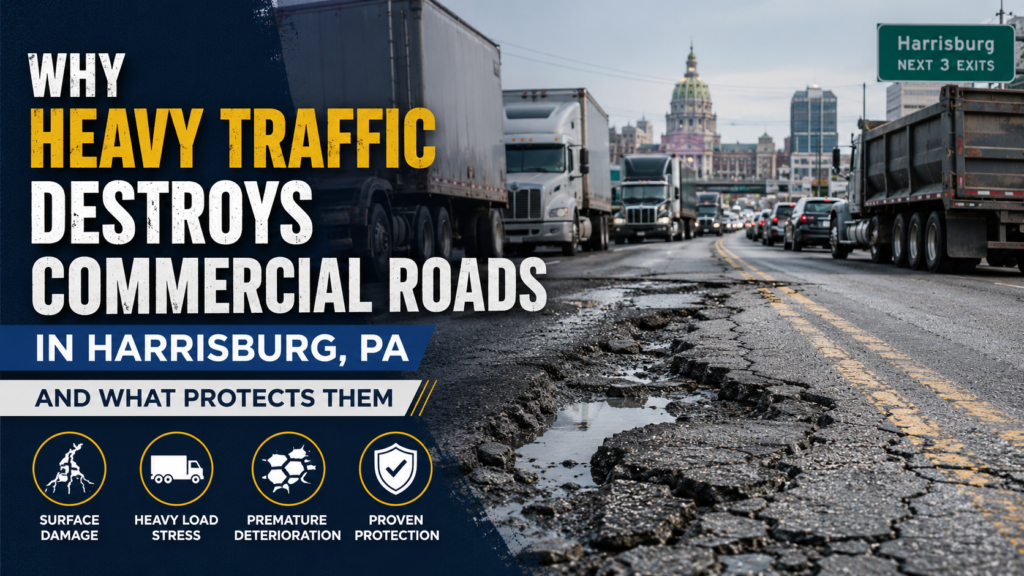
Commercial roads, access drives, and parking areas in Harrisburg face a challenge that residential driveways do not: the loading conditions they experience every day are often far beyond what was anticipated when they were designed and built. A parking lot originally built for passenger vehicles now serving daily delivery truck traffic. A Commercial Road Asphalt Harrisburg access road that was adequate for a small industrial tenant now handling 40-foot tractor-trailers. In Central Pennsylvania climate where freeze-thaw cycling already places relentless stress on every paved surface adding traffic loads that exceed the pavement structural capacity accelerates deterioration dramatically. Understanding the specific mechanisms by which heavy traffic destroys commercial asphalt helps Harrisburg property managers recognize the problem early and respond appropriately.
How Asphalt Is Designed for Load: The Basics
Asphalt pavement is a layered structural system, not simply a surface treatment. The asphalt surface distributes loads over the aggregate base below, which distributes them over the sub-grade native soil. The design of each layer thickness, material specifications, and compaction requirements is determined by anticipated traffic loading, expressed in Equivalent Single Axle Loads (ESALs).
A single loaded tractor-trailer applies loads equivalent to thousands of passenger vehicle passes. A parking lot designed for passenger vehicles with 4 inches of aggregate base and 2.5 inches of asphalt may be entirely appropriate for a retail shopping center and completely inadequate for a distribution center with daily 18-wheeler access. This structural mismatch between actual loading and design capacity is the fundamental driver of premature commercial pavement failure in Harrisburg.
The Specific Ways Heavy Traffic Destroys Asphalt
- Structural fatigue cracking: When pavement is repeatedly loaded beyond its structural capacity, the asphalt layer flexes more than its design allows. Each flex cycle advances micro-cracking through the asphalt matrix fatigue. The cumulative result is alligator cracking, signaling the pavement has exhausted its structural reserve. This cannot be corrected by surface treatment alone.
- Rutting: Heavy vehicles apply concentrated point loads to asphalt surfaces. When pavement temperatures are elevated during Harrisburg summers, asphalt binder softens and these concentrated loads can permanently deform the surface, creating ruts in wheel tracks. Rutted surfaces collect water and create vehicle handling hazards.
- Edge failure: Commercial vehicles with wider wheel tracks apply loads near pavement edges that lack lateral confinement. Unsupported pavement edges break off under these loads, creating progressive edge failures advancing inward from lot perimeters.
- Premature base failure: Heavy loads compress the aggregate base and sub-grade. In areas with clay-rich sub-grade soils common in parts of the Harrisburg region prolonged heavy loading under wet conditions can push base material into the sub-grade, causing settlement and loss of structural support.
The Spring Thaw Period: Peak Vulnerability
Central Pennsylvania climate interacts with heavy traffic loading in ways that amplify damage beyond what either factor causes alone. The spring thaw period when frozen sub-grade soils melt from the surface down, temporarily trapping water in a saturated layer above still-frozen material dramatically reduces pavement bearing capacity. Pennsylvania imposes spring weight restrictions on secondary roads to protect them during this vulnerable period. Commercial asphalt in Harrisburg that was already marginally adequate for its loading conditions is most vulnerable to catastrophic failure during spring thaw, when the sub-grade is at its weakest.
Design Solutions for Heavy Traffic Applications
When commercial asphalt in Harrisburg must accommodate heavy vehicle traffic, the pavement structure must be specifically designed for those loads. This means greater aggregate base depth 8 to 12 inches or more for heavy truck applications compared to 4 to 6 inches for standard commercial heavier asphalt surface course thickness, specification of asphalt mixes with appropriate stiffness for the load and temperature environment, and channelizing heavy vehicle movements to defined areas that can be constructed and maintained to appropriate specifications while protecting lighter-duty areas.
Conclusion
Heavy traffic destroys commercial asphalt in Harrisburg by applying loading that exceeds structural capacity of pavement designed for lighter use. Fatigue cracking, rutting, edge failure, and base degradation are all direct consequences, compounded by Central Pennsylvania freeze-thaw cycles and the spring thaw period that temporarily reduces bearing capacity. Protecting commercial pavement from heavy traffic damage requires designing to actual loading conditions from the outset, channelizing heavy movements to appropriately specified surfaces, and maintaining those surfaces with the monitoring and intervention that real-world commercial loading demands.